

Lifetime gifting can be an effective way to manage potential UK Inheritance Tax (IHT) exposure, but the rules surrounding lifetime gifts are often misunderstood. A common assumption is that a gift becomes free from IHT as long as the donor survives for seven years. That is not always the case. UK IHT legislation distinguishes between two important types of lifetime transfer: Potentially Exempt Transfers and Chargeable Lifetime Transfers.
The distinction matters because PETs and CLTs are treated differently for IHT purposes. They can have different immediate tax consequences, reporting requirements and outcomes if the donor dies within seven years. Understanding which category a gift falls into can therefore help avoid unexpected tax charges and administrative problems for both donors and beneficiaries.
What is a Potentially Exempt Transfer (PET)?
A Potentially Exempt Transfer (PET) is a lifetime transfer that is not immediately chargeable to IHT when made, but can become chargeable if the donor dies within seven years.
- Outright Gifts: The most common example is an outright gift made by one individual to another individual.
- Disabled Persons’ Trusts: Certain qualifying transfers into trusts created for disabled beneficiaries can also qualify as PETs.
- Bare Trusts: Ordinary bare-trust arrangements can receive PET treatment because, for IHT purposes, the trust property is treated as belonging directly to the beneficiary.
A PET carries no immediate IHT charge. If the donor survives seven years from the date of the gift, it becomes an exempt transfer and falls entirely outside the estate. If the donor dies within seven years, it becomes a failed PET and is brought into the IHT calculation.
What is a Chargeable Lifetime Transfers (CLT)?
A Chargeable Lifetime Transfers is any lifetime transfer of value by an individual that is neither an exempt transfer nor a PET.
- Relevant Property Trusts: The most common example is a transfer into a relevant-property trust, such as a discretionary trust.
- Lifetime Tax Charge: Unlike a PET, an immediately chargeable transfer is tested against the donor’s available Nil-Rate Band (NRB) at the time the gift is made.
- Effective Tax Rate: Lifetime IHT is charged at 20% on any amount exceeding the donor’s available NRB if the trustees/transferee pay the tax. If the donor bears the tax, grossing-up applies, producing an effective 25% tax cost relative to the original net excess transferred.
Key Differences: PETs vs. Chargeable Lifetime Transfers (CLTs)
| Feature | Potentially Exempt Transfer (PET) | Immediately Chargeable Transfer (CLT) |
|---|---|---|
| Typical Structure | Outright gift to another individual; certain qualifying disabled trusts; some bare-trust arrangements. | Transfer into a relevant-property trust, such as a discretionary trust. |
| IHT When Made | No immediate IHT. | Potential lifetime IHT at 20% on the taxable excess. |
| If Donor Pays Tax | Not applicable. | Grossing-up produces an effective 25% tax cost on the original net taxable excess. |
| HMRC Reporting | Generally none when made. | Form IHT100 may be required, subject to the excepted-transfer rules. |
| Survive 7 Years | Becomes exempt. | No additional death charge; lifetime tax paid is non-refundable. |
| Die Within 7 Years | Becomes a failed PET and is assessed at death rates. | Additional IHT may arise after recalculation at death rates, with credit for lifetime tax already paid. |
| Taper Relief | May reduce IHT attributable to the failed PET. | May reduce the recalculated death liability. |
| Trust Charges | Generally none merely because it is a PET. | Relevant-property trusts can face 10-year anniversary and exit charges. |
Death Within 7 Years and Taper Relief
If a donor dies within seven years of making an immediately chargeable transfer or a PET, the gift must be reassessed at the full death rate of 40%.
Where IHT is payable on the transfer, taper relief reduces the tax charge depending on how long the donor survived after making the gift.
| Period Between Gift and Death | Reduction in IHT Attributable to Gift | IHT Payable on Taxable Excess |
| Less than 3 years | 0% | 40% |
| 3 to 4 years | 20% | 32% |
| 4 to 5 years | 40% | 24% |
| 5 to 6 years | 60% | 16% |
| 6 to 7 years | 80% | 8% |
| 7+ years | 100% | 0% |
Important Note on Taper Relief: Taper relief reduces the tax payable, not the statutory IHT rate or the taxable value of the underlying gift. Taper relief does not apply merely because three years have passed; there must first be IHT attributable to the transfer after taking account of the available nil-rate band and other relevant reliefs.
The “14-Year Rule” Interaction Explained
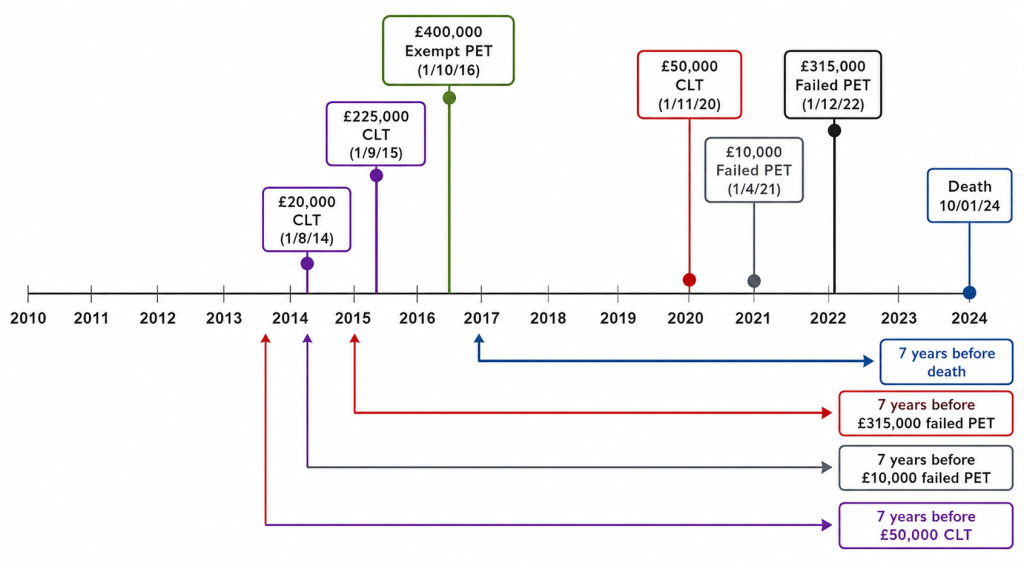
The IHT system does not generally impose a 14-year lookback. The potential 14-year period arises specifically from the interaction between a failed PET and an earlier chargeable lifetime transfers.
Mechanics of the Interaction
When assessing a failed PET following a donor’s death, HMRC examines all chargeable transfers made by the donor in the seven years preceding the PET.
- Year 1: Donor makes an immediately chargeable transfer (CLT) of £300,000.
- Year 5: Donor makes a PET of £300,000.
- Year 10: Donor dies.
Analysis:
- The Year 1 CLT occurred 9 years before death, so it incurs no direct death charge.
- The Year 5 PET occurred 5 years before death, making it a failed PET subject to IHT.
- To determine the Nil-Rate Band available for the failed PET, HMRC looks back 7 years from the date of the PET (Year 5).
- The Year 1 CLT falls within that 7-year lookback window and absorbs £300,000 of the £325,000 Nil-Rate Band.
- Only £25,000 of the NRB remains available against the £300,000 failed PET, leaving £275,000 subject to IHT before taper relief.
Practical Example: Recalculating Tax on Death
Consider George, who made two lifetime transfers before dying:
- Year 1: Gift of £325,000 into a discretionary trust (CLT).
- Year 3: Outright gift of £500,000 to his daughter (PET).
- Year 7: George dies (6 years after the CLT, 4 years after the PET).
1. Reassessing the PET (Year 3)
- The PET occurred 4 years before death (failed PET).
- Looking back 7 years from Year 3 captures the Year 1 CLT of £325,000.
- The Year 1 CLT uses the full £325,000 NRB. The PET has £0 NRB available.
- Taxable amount = £500,000 at 40% = £200,000.
- Taper relief for survival between 4–5 years (40% reduction): £120,000 IHT payable by the daughter.
2. Reassessing the CLT (Year 1)
- The CLT occurred 6 years before death, so it must be recalculated at death rates.
- Available NRB at Year 1 = £325,000. Taxable excess = £0.
- Initial lifetime tax paid at Year 1 = £0.
- On reassessment at death: Gross tax at 40% = £0. Additional tax due = £0.
Reporting Requirements: Form IHT100
A lifetime transfer may need to be reported to HMRC using Form IHT100 where IHT is payable or where the transfer falls outside the excepted-transfer rules.
The excepted-transfer rules contain specific statutory conditions, including:
- An 80% nil-rate-band test (where the cumulative value transferred must not exceed 80% of the active NRB).
- Additional conditions depending on the nature of the property transferred (e.g., transfers involving property other than cash or quoted stocks/shares carry further testing requirements).
Capital Gains Tax (CGT) Interaction
When gifting assets during lifetime, both Capital Gains Tax and IHT must be evaluated:
- Section 260 TCGA 1992 Hold-Over Relief: A transfer into a relevant-property trust (immediately chargeable transfer) may qualify for CGT hold-over relief under Section 260 because it is a chargeable transfer for IHT purposes.
- Ordinary PETs: An ordinary PET does not qualify for Section 260 hold-over relief merely because it is a gift. Separate business-asset hold-over relief under Section 165 TCGA 1992 may apply if its specific qualifying conditions are met.
Gifts with Reservation of Benefit (GROB)
Where an individual gifts an asset but retains a benefit (e.g., gifting a house while continuing to live in it rent-free):
- Where the reservation continues until death, the property remains within the donor’s estate for IHT purposes; the original gift does not become an effective PET simply because seven years have elapsed.
- If the reservation later ceases during the donor’s lifetime, a new PET analysis applies from the date the reservation ends.
Nil-Rate Band & Residence Nil-Rate Band (RNRB)
Note on Tax-Free Thresholds: The £325,000 threshold referenced throughout this guide refers to the standard Nil-Rate Band (NRB). On death, an additional Residence Nil-Rate Band (RNRB) of up to £175,000 may be available if qualifying residential property is left to direct descendants (subject to tapering for net estates exceeding £2 million).
The RNRB applies on death and does not operate as an additional lifetime nil-rate band for calculating lifetime tax charges on PETs or immediately chargeable transfers.
Why professional IHT advice matters
UK Inheritance Tax is an intricate framework where small structural details significantly alter financial outcomes for families and trustees.
Professional guidance from a qualified UK tax adviser is essential, particularly where:
- Trusts are established: Relevant property trusts require ongoing administration, including monitoring 10-year anniversary charges and exit charges.
- Business or agricultural assets are gifted: Navigating specific statutory reliefs such as Business Property Relief (BPR) and Agricultural Property Relief (APR) requires careful structuring to ensure lifetime transfers qualify fully without triggering unexpected charges.
- Retained benefits are concerned: Structuring formal lease arrangements or shared property ownership to avoid GROB traps requires precise legal drafting and commercial valuation support.
- Long-term liquidity is required: Lifetime gifts are irrevocable. Tax advisers undertake cash flow modelling to ensure donors retain sufficient assets to maintain their lifestyle and cover potential care costs.
Conclusion
Understanding the operational differences between Chargeable Lifetime Transfers and Potentially Exempt Transfers is essential for effective UK estate planning. Outright gifts offer simplicity and the potential for complete tax exemption after seven years, whereas trust transfers provide control and long-term asset protection at the cost of immediate tax considerations and ongoing compliance.
Successful lifetime planning extends far beyond simply making gifts; it requires deliberate sequencing, an accurate understanding of nil-rate band cumulation and taper relief, and vigilant avoidance of statutory traps such as reservation of benefit. By engaging proactive advice from a UK IHT specialist, individuals can protect family wealth across generations while remaining fully compliant with HMRC rules.
Frequently Asked Questions
1. What is the fundamental difference between a PET and a CLT?
A Potentially Exempt Transfer (PET), such as an outright cash gift to an individual, carries no upfront tax charge when made. It becomes completely tax-exempt if the donor survives seven years. An Immediately Chargeable Transfer (CLT), such as a gift into a discretionary trust, is tested immediately against the donor’s £325,000 Nil-Rate Band (NRB). Any excess above the available NRB incurs an immediate 20% lifetime IHT charge (or 25% if the donor pays the tax).
2. How does Taper Relief actually reduce Inheritance Tax?
Taper relief reduces the amount of tax payable on a failed PET or CLT, not the underlying value of the gift or the statutory tax rate. The tax liability drops by 20% for each full year survived beyond three years after making the gift (e.g., a 40% tax reduction for surviving 4–5 years). Taper relief only provides a saving if the gift exceeds the donor’s available NRB; if the gift is fully covered by the NRB, no tax is owed and taper relief does not apply.
3. Why is it called the “14-Year Rule” if the primary IHT window is 7 years?
The 14-year timeline occurs when assessing a PET that fails because the donor died within seven years. When recalculating tax on that failed PET, HMRC looks back seven years from the date the PET was made to check for earlier CLTs. If a CLT was made up to seven years prior to the PET, it absorbs the donor’s NRB first. If the donor then dies within seven years of the PET, events spanning up to 14 years before death directly affect the tax due.
4. How do Capital Gains Tax (CGT) rules differ between PETs and CLTs?
Transfers into discretionary trusts (CLTs) generally qualify for Section 260 TCGA 1992 hold-over relief, allowing capital gains to be deferred regardless of asset type. Outright gifts to individuals (PETs) do not qualify for Section 260 relief. Unless the gifted asset qualifies for business or agricultural hold-over relief under Section 165, gifting property or shares directly triggers an immediate CGT disposal at market value.
5. What happens if a donor gifts an asset but continues to use it?
This triggers the Gift with Reservation of Benefit (GROB) rules. If a donor gifts an asset (such as a residential home) but continues to live there rent-free or retain a benefit, the seven-year PET clock does not start. Upon the donor’s death, the full market value of the property remains inside the estate for IHT purposes.
